Monday, June 14, 2021

Masks... or No Masks?

We've been seeing a lot of Covid-placed restrictions lifted in Michigan the past few weeks. Yes Michigan, home of the legendary governor who follows her own guidelines...when she feels like it.(This would almost be funny, if it didn't happen so often.)

All of the restrictions in Michigan, and hopefully other states, are supposed to lift July 1st, though many are in evidence now. One of the biggest changes is the lack of masks. Although 'masks recommended' or even 'mask required' signs are still everywhere, hardly anyone is wearing them. A few are, here and there, and even those are mostly workers that are required to do so, I assume, by their bosses.

Other than that? Bright shiny faces everywhere -- including ours. I wore a mask when it was required -- because it was required. I kept it on, even when I could barely breathe. (Although I didn't wear it outside -- that just seemed silly. I kept social distancing, though.) 

Was it all for little or no reason? I'm not sure. 

 A very interesting study was released recently from the CDC regarding mask-wearing. (I heard about it first from this guy, but the CDC study results are the same. Have major media sources been talking much about it? Naaahhh...)

Here's the general sumup, directly from the CDC study; it's a bit difficult to follow, but the conclusions are important.  (Or check the tables at the end of this article -- also from the CDC.) Emphasizing italics are mine.

---------------------

During March 1–December 31, 2020, state-issued mask mandates applied in 2,313 (73.6%) of the 3,142 U.S. counties. Mask mandates were associated with a 0.5 percentage point decrease (p = 0.02) in daily COVID-19 case growth rates 1–20 days after implementation and decreases of 1.1, 1.5, 1.7, and 1.8 percentage points 21–40, 41–60, 61–80, and 81–100 days, respectively, after implementation (p<0.01 for all) (Table 1) (Figure). Mask mandates were associated with a 0.7 percentage point decrease (p = 0.03) in daily COVID-19 death growth rates 1–20 days after implementation and decreases of 1.0, 1.4, 1.6, and 1.9 percentage points 21–40, 41–60, 61–80, and 81–100 days, respectively, after implementation (p<0.01 for all). Daily case and death growth rates before implementation of mask mandates were not statistically different from the reference period. (The CDC said this straight out Notice decreases are less than two percent, at worst.)

During the study period, states allowed restaurants to reopen for on-premises dining in 3,076 (97.9%) U.S. counties. Changes in daily COVID-19 case and death growth rates were not statistically significant 1–20 and 21–40 days after restrictions were lifted. Allowing on-premises dining at restaurants was associated with 0.9 (p = 0.02), 1.2 (p<0.01), and 1.1 (p = 0.04) percentage point increases in the case growth rate 41–60, 61–80, and 81–100 days, respectively, after restrictions were lifted (Table 2) (Figure). Allowing on-premises dining at restaurants was associated with 2.2 and 3.0 percentage point increases in the death growth rate 61–80 and 81–100 days, respectively, after restrictions were lifted (p<0.01 for both). Daily death growth rates before restrictions were lifted were not statistically different from those during the reference period, whereas significant differences in daily case growth rates were observed 41–60 days before restrictions were lifted.

Studies have confirmed the effectiveness of community mitigation measures in reducing the prevalence of COVID-19 (58). Mask mandates are associated with reductions in COVID-19 case and hospitalization growth rates (6,7), whereas reopening on-premises dining at restaurants, a known risk factor associated with SARS-CoV-2 infection (2), is associated with increased COVID-19 cases and deaths, particularly in the absence of mask mandates (8). The current study builds upon this evidence by accounting for county-level variation in state-issued mitigation measures and highlights the importance of a comprehensive strategy to decrease exposure to and transmission of SARS-CoV-2. Prohibiting on-premises restaurant dining might assist in limiting potential exposure to SARS-CoV-2; however, such orders might disrupt daily life and have an adverse impact on the economy and the food services industry (9). If on-premises restaurant dining options are not prohibited, CDC offers considerations for operators and customers which can reduce the risk of spreading COVID-19 in restaurant settings.*** COVID-19 case and death growth rates might also have increased because of persons engaging in close contact activities other than or in addition to on-premises restaurant dining in response to perceived reduced risk as a result of states allowing restaurants to reopen. Further studies are needed to assess the effect of a multicomponent community mitigation strategy on economic activity.

The findings in this report are subject to at least three limitations. First, although models controlled for mask mandates, restaurant and bar closures, stay-at-home orders, and gathering bans, the models did not control for other policies that might affect case and death rates, including other types of business closures, physical distancing recommendations, policies issued by localities, and variances granted by states to certain counties if variances were not made publicly available. Second, compliance with and enforcement of policies were not measured. Finally, the analysis did not differentiate between indoor and outdoor dining, adequacy of ventilation, and adherence to physical distancing and occupancy requirements.

----------------------------

(Heads-up, Trolls among my Gentle Readers. If you want to argue with the results, go complain to the CDC. They're the ones who compiled these numbers -- not me. Don't think I'm gloating; this was not a fun post to write.)

---------------------------

So...wearing masks made a big difference. And that's why the CDC is continuing to not only strongly promote their use, but state that they made a big difference in infection rates. 

Not exactly. 

And keeping those restaurants and other public places closed, thus destroying businesses, employees and crippling our country and everyday lives, was worth it -- because Covid infection rates substantially decreased. 

Again, not exactly. 

Yes, I'm aware that that defining 2%, or even 4%, may have saved the lives of some people...especially if they had previous health conditions. The CDC does not mention them in this survey. (Could their numbers be skewing the survey results even more?) 

So, in spite of the extremely small percentages, the CDC continues to strongly promote wearing masks. Why? Dr. Anthony Fauci has been equally disingenuous. In spite of a Feb. 2020 e-mail to a Team Obama health official that says masks were for infected people, not healthy ones, the good doctor continued to push (and wear) a mask. ("...the typical mask you buy in a drug store is not really effective in keeping out the virus, which is small enough to pass through the material.")

Says the editorial:

'Fauci now claims that new information emerged in the time since that email proving the efficacy of masks. But did it? What was that new information?

Did the virus magically grow in size, so that the masks could contain it? When he referred to masks in the drug store at that point, he meant medical masks. But most Americans spent more than a year wearing cloth masks. If medical masks couldn’t contain the tiny ­virus, how could the cloth ones? Can Fauci point to any studies showing that masks made a significant difference in containing the coronavirus?'

After all, says Fauci, attacks on him are attacks on science. 

(Just like this guy, I guess.)


Now that most people are not wearing masks, probably the only way to know whether we're going to have another major outbreak, due to our 'carelessness,' is to wait -- and compare the 2021 numbers to the 2020 results. But in a way, I don't want to know. I don't want to find out that a lot of the irritating and damaging 'precautions' we took to avoid this disease...

really didn't matter that much. 

Time will tell.


Tables furnished by the CDC. (See the link in the first paragraph.)

TABLE 1. Association between state-issued mask mandates* and changes in COVID-19 case and death growth rates — United States, March 1–December 31, 2020Return to your place in the text
Time relative to day state mask mandate was implementedCase growth ratesDeath growth rates
Percentage point change (95% CI)p-value§Percentage point change (95% CI)p-value§
41–60 days before0.0 (−0.7 to 0.7)0.98−0.8 (−1.8 to 0.1)0.07
21–40 days before0.5 (−0.8 to 1.8)0.490.3 (−0.8 to 1.5)0.56
1–20 days beforeReferentReferent
1–20 days after−0.5 (−0.8 to −0.1)0.02−0.7 (−1.4 to −0.1)0.03
21–40 days after−1.1 (−1.6 to −0.6)<0.01−1.0 (−1.7 to −0.3)<0.01
41–60 days after−1.5 (−2.1 to −0.8)<0.01−1.4 (−2.2 to −0.6)<0.01
61–80 days after−1.7 (−2.6 to −0.9)<0.01−1.6 (−2.4 to −0.7)<0.01
81–100 days after−1.8 (−2.8 to −0.7)<0.01−1.9 (−3.0 to −0.8)<0.01

Abbreviation: CI = confidence interval.
* A state-issued mask mandate was defined as the requirement that persons operating in a personal capacity (i.e., not limited to specific professions or employees) wear a mask 1) anywhere outside their home or 2) in retail businesses and in restaurants or food establishments.
 Percentage points are coefficients from the weighted least-squares regression models. Reported numbers are from regression models, which controlled for county, time (day), COVID-19 tests per 100,000 persons, closure of restaurants for any on-premises dining, closure of bars for any on-premises dining, and the presence of gathering bans and stay-at-home orders.
§ P-values <0.05 were considered statistically significant.

Return to your place in the textFIGUREAssociation between changes in COVID-19 case and death growth rates* and implementation of state mask mandates (A) and states allowing any on-premises restaurant dining§ (B) — United States, March 1–December 31, 2020
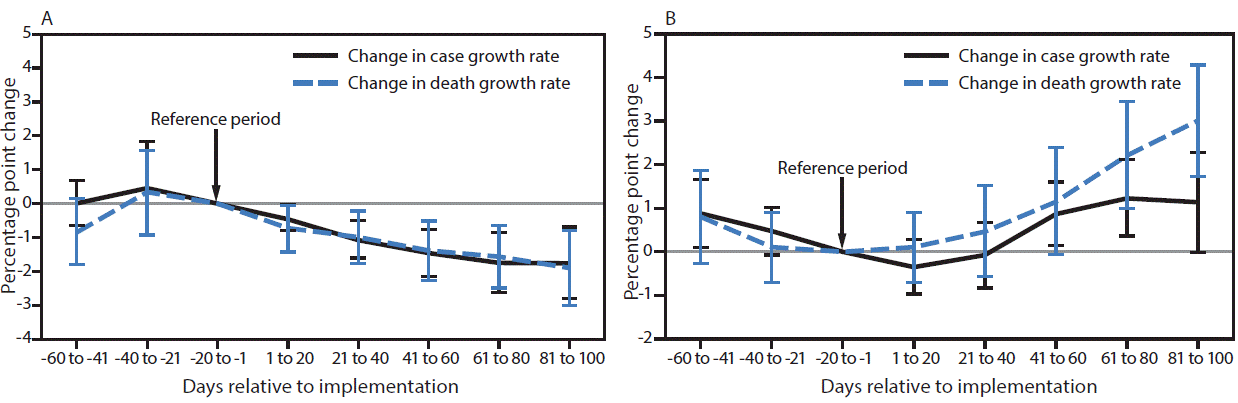
The figure is a pair of line graphs showing the association between changes in COVID-19 case and death growth rates and implementation of mask mandates and allowing on-premises restaurant dining in the United States during March 1–December 31, 2020.


* With 95% confidence intervals indicated with error bars.

 A state-issued mask mandate was defined as the requirement that persons operating in a personal capacity (i.e., not limited to specific professions or employees) wear a mask 1) anywhere outside their home or 2) in retail businesses and in restaurants or food establishments.

§ The effective date of the state order allowing restaurants to conduct any on-premises dining or the date a state-issued restaurant closure expired.

TABLE 2. Association between states allowing any on-premises restaurant dining* and changes in COVID-19 case and death growth rates — United States, March 1–December 31, 2020Return to your place in the text
Time relative to day states allowed on-premises diningCase growth ratesDeath growth rates
Percentage point change (95% CI)p-value§Percentage point change (95% CI)p-value§
41–60 days before0.9 (0.1 to 1.6)0.020.8 (−0.2 to 1.8)0.13
21–40 days before0.5 (−0.1 to 1.0)0.080.1 (−0.7 to 0.9)0.78
1–20 days beforeReferentReferent
1–20 days after−0.4 (−0.9 to 0.2)0.220.1 (−0.7 to 0.9)0.78
21–40 days after−0.1 (−0.8 to 0.6)0.830.5 (−0.5 to 1.5)0.36
41–60 days after0.9 (0.2 to 1.6)0.021.1 (−0.1 to 2.3)0.06
61–80 days after1.2 (0.4 to 2.1)<0.012.2 (1.0 to 3.4)<0.01
81–100 days after1.1 (0.0 to 2.2)0.043.0 (1.8 to 4.3)<0.01

Abbreviation: CI = confidence interval.
* The effective date of the state order allowing restaurants to conduct any on-premises dining or the date a state-issued restaurant closure expired.
 Percentage points are coefficients from the weighted least-squares regression models. Reported numbers are from regression models, which controlled for county, time (day), COVID-19 tests per 100,000 persons, mask mandates, closure of bars for any on-premises dining, and the presence of gathering bans and stay-at-home orders.
§ P-values <0.05 were considered statistically significant.


Dandelion photos by Greg Hume via Wikipedia: 

Thursday, June 10, 2021

Figures...

    The Oxford University student who (successfully) got up the motion to remove the Queen's portrait from Magdelen College's Middle Common Room is... American.

He said then that keeping Queen Elizabeth's portrait in place "represents recent colonial history." Which obviously is BAD. (Then again, the whole Revolution wasn't so good for us as a nation.)


The 'threatening' portrait in question. Oooh, I'm terrified. (from the article link)


NOW he says it's not a statement on the Queen. It's more because the Royal Family's portraits are cluttering up a bunch of other places around campus. Why add one more? 

You'd also figure this, but it seems that his wealthy parents have been funding his education - both here, and at some very expensive (as in $48,000+/yr) private schools. His previous alma mater included the Obama daughters, Chelsea Clinton, President Biden's grandchildren -- and a bunch of other offspring from various presidents and Important People. That gives him plenty of time to worry about important issues, like Queen Elizabeth's portrait. Is our 'hero' working to pay his way through school? I'd seriously doubt it. Hopefully he is studying hard, at least. 

Our 'hero's' favorite character? Captain America. (Maybe he should go up, in Her Majesty's place!)


No wonder the Brits aren't too thrilled about us right now. If they ever were...

Wednesday, June 9, 2021

'Ring of Fire' Solar Eclipse Happens on Thursday

A partial solar eclipse is happening on Thursday. According to Live Science.com,  

The entire annular solar eclipse will last about 100 minutes, starting at sunrise in Ontario, Canada, and traveling northward until the moment of greatest eclipse, around 8:41 a.m. local time in Greenland (6:41 a.m. EDT; 11:41 GMT) 10:41 UTC in northern Greenland and ending at sunset in northeastern Siberia, according to EarthSky. The "ring of fire" phase, when the moon covers 89% of the sun, will last up to 3 minutes and 51 seconds at every point along this path.

 All is not lost if you're not a Greenlander.

Come regions that don't fall along the solar eclipse's path will see a partial eclipse, weather permitting. In these areas, part of the moon's outer, lighter shadow, known as the penumbra, blocks the sun. As the moon passes in front of the sun, it will look like this shadow took a sumptuous bite out of the bright star. For viewers in the United States, it's best to watch before, during and shortly after sunrise, depending on your location, especially if you're in parts of the Southeast, Northeast or Midwest, or in northern Alaska, NASA reported.


We're out of luck this time in Colorado. Maybe in December, when the next eclipse is scheduled.

And yes, if you're thinking what I am, you're hearing...


Monday, June 7, 2021

Monday Stuff On the Way to Other Stuff: Amish...and Not So Much

     We just got back, from a few days' vacation in Shipshewana, Indiana. 

photo from aimindiana.org


If you've never been there, the easiest way to describe it: a longtime Amish settlement that's turned tourist. REALLY tourist. A quaint town,.but with a regionally-known auction and flea market that many people enjoy. Not to mention a bunch of bulk food and discounted-item stores, hardware and quilt shops...even a popcorn store. 

    We also enjoyed gawking (or trying not to) at the Amish, their well-kept farms, buggies and their colorful, beautifully-simple clothing. (I was particularly impressed by the many snowy aprons and caps. How DO they get them so white!) 

     I have had a deep respect for the Amish women I've talked with. (No, I don't discuss things with Amish guys.) They are friendly, knowledgeable (usually we talked about quilts, gardening and groceries) and very, very smart. They are some of the most frugal, resourceful and religiously faithful groups I know. (The Mennonites, though their customs differ a little, also fall into this category. One of my appraising colleagues is Mennonite, as were good friends we made when living in Ann Arbor.)

     The bulk food stores were full of people, Amish and 'English,' busily shopping before they closed at 4 p.m. (Most stores are closed on Sundays in Shipshewana, though Saturday was the 'closed' day in Jamesport, MO, another Amish town we've visited.) We got our share of bargains there, too. (Or, as I often crow to the Brick, "Boy, did I save you money!") If you need oil lamp chimneys, basic gardening tools, and even quilting fabric, this is a great place to visit. But don't expect all the items to be truly Amish. They're not. 

Amish quilts, for example. (These are all from Amish Country Lanes in Pennsylvania. Beautifully made, by the way, based on the photos. Amish and Mennonite quilters are proud of their workmanship.)

Amish quilts, made for Amish (and admirers): solids, often jewel tones and contrasting neutrals. Though cottons dominate, polyester blends are not unusual. (Easy care, after all). Older quilts may use wools, which are incredibly rich in tone. Classic designs most popular. (This one is from Hannah's Quilts.)

'Sunshine and Shadows' -- I would call this a Trip Around the World variation -- on point


Mennonite quilts: similar in many ways to Amish pieces, with their love of classic design and pattern. These, however, are allowed to use small prints, if desired. (This one is from Connie Lapp and her mom.)

  'Hit and Miss'


Postage stamp style.  Notice the small-scale prints?


'English' quilts: made for non-Amish and non-Mennonite customers. Sky's the limit with prints and pattern, though they will often use 'quick' techniques on piecing, in particular, to make the quilts faster-made and more reasonably-priced. (This Christmas beauty is from Ruth Flaud, a Mennonite quilter.)

  'Christmas Dahlia'

So there you go. 

Anyways, we went to Shipshewana with dear cousins. We had a wonderful time, going to a play at the Blue Gate Theater, and just hanging out, shopping, and eating. And of course, gawking. (Or trying not to.) Meanwhile: 

A teacher loans a student his own shoes, so the student could graduate. Good for him!

Creative ways to solve various problems -- including showing movies on the side of a cow!


(Having grown up on a farm with cattle...How did they get her to stand there so long!)

Dr. Fauci gets into an angry debate with seventeen previous versions of himself. Is this satire, Babylon Bee...ummm, maybe not.

Dogs saved after she shoved A BEAR off the wall. Foolish of this 17-year-old...but heroic.

How to get your floor tiles extra glossy? This cleaning expert says extra-hot water and dishwashing liquid. But if you're low-maintenance, she just advises 'ripping them out.' Go figure...

Bake your cinnamon rolls in the wafflemaker!


Setting up a soaking pool in your yard,with step by step videos, thanks to Rae. (From A Life By Design) Or, if you prefer:

Want to go swimming in the sky -- between two apartment buildings? Now you can. 

A speedboat blows up after the people are incredibly rude...all I can say: 'be sure your sins will find you out.'

Why did Sinead O'Connor rip up the photo of the pope on SNL? Turns out it was revenge on her mother, as much as anything! (That was actually Mom's photo of the Pope that Sinead ripped up...)

'A Collection of Corrections.' Oh, that all 'factual' websites would do this. (CNN, are you listening?)

Racial bias in the appraiser/appraisal field, for black appraisers and homeowners? Sadly, yes. Hopefully this will change -- and continue to change -- in the future.

A Minneapolis' BLM leader quits...why?

Top ten snipers in history. This is interesting...and a bit unnerving, at the same time. Thanks for freaking us out, Listverse.

'Dirty secrets from cooking at home' and 'How to stop eating out.' (Including readers' contributions.) Both great advice posts from the Frugalwoods.


"I can't even put food on the table." (From I - heart- Budgets) Maybe she would benefit from:

Super-thrifty meals that stretch budgets.  (From Thrifty Mom in Boise)

Frugal savers' advice for navigating in this strange post-Covid world.

"What is it like to win a lottery?" The good, bad and anonymous. (Thanks, Quora people.)

Thieves stole the rosary of Mary, Queen of Scots! And other priceless relics, as well. (Based on the items taken, police think they were 'pickers' for some rich but unscrupulous collector.)


Have a great week.

An Amish family near Morristown, NY.  (Wikipedia)
The buildings we saw looked freshly painted - and spotless.

Friday, June 4, 2021

Looking for a Good Spooky Book?

 It's here! 

 Ghostly Tales of Colorado's Front Range is out, to the shivery delight of children everywhere. Its author, Shelli Timmons, took yours truly's book, Ghosts and Legends of Colorado's Front Range, and adapted some of the stories for kids, in Arcadia Publishing's 'Spooky America' line. Very cool illustrations, too! 

Click on the Arcadia and Amazon links below, then on the book photo, and you can read a healthy sampling of the pages inside. Ditto for Ghosts & Legends.

Remember telling stories around the campfire...or in the tent during summertime... watching the embers or fireflies play together? 

Now you've got fresh ammunition. 

Take a look here.  Or if you prefer Amazon, it's here.

Brickworks will be selling copies later this month, as soon as the offices reopen. (We closed them while traveling.)


Have fun. And for adults who prefer even more variety, my original book is still out there, too. (Yes, we'll be offering a package deal!)


Colorado Curiosities will be out the end of this month, for even more oddball tales of the Centennial State. More fuel for the fire.


 Enjoy.

Tuesday, June 1, 2021

Monday (Nope, Tuesday) Stuff On the Way to Other Stuff: Places to Go, People to See


    I just ran into a great new trending word. Remember the creatures on Sesame Street?


Several times these past few weeks, I've come across people saying they're trying to avoid an unpleasant commitment by "noping" out of it. I think we've got a new verb in the stratosphere...

Now that the clock's winding down, we suddenly have a bunch of invitations and tasks to deal with. This weekend is a visit to Shipshewana, IN with cousins -- we'd planned to keep going to Colorado after that, but now it seems we need to come back to Michigan, instead, for a few more days. Maybe we just need to "nope" out and head for home, anyways. Who knows at this point. 


Here's math for you: 1.6 million pounds spent on a glitzy fundraising gala -- but 5,515 pounds was the total actually sent to the causes touted. Hey, good onya, Naomi Campbell and Fashion for Relief!

Several countries that let you stay while working -- as long as your salary and insurance are up to par.

Forty-seven years' service at the White House! Thank you, Mr. Carter, for your dedication and hard work. It's not just the Presidents and their families you've been taking care of, you know...it's us, the American people, too. Thank you. 

'Dump and go' dinners, including Betty Crocker's easy take on ravioli: spinach and ravioli lasagne.

Listverse takes a look at the Wuhan lab -- and its connection to Covid-19.

Very funny notes from annoyed neighbors.

Are you a graffiti artist? Elon Musk wants you to decorate his factory in Berlin!

"This Week in Whoppers."  Not sandwiches, either. (More whoppers here -- and they're just as interesting.) Speaking of:

The BLM co-founder who was buying millions of dollars in luxury homes to "combat white supremacy" has resigned from BLM. Why? Her work here is done, says she. (Also, she's working on a "book and tv deal.") Go figure. I'm not the only one suspicious about her timing, either.

One of the funniest baseball plays in ages! Cubs player Baez makes the Pirate players look like idiots. (Or maybe they did it to themselves.) Speaking of Chicago:

The mayor of Chicago is sued for 'blatant discrimination.'  For not granting a white reporter an interview. (She did let a national reporter, who was white, interview her recently. Maybe she changed her mind. Discrimination is discrimination, no matter who you do it to.)

The Wall Street Journal wants to talk about the Covid/Wuhan lab theory now. Did it change it mind, as well?

The Atlantic mayoral candidate who urged police defunding had his car stolen -- and recovered by the police. And suddenly he's verrry grateful to our men and women in blue. Hmmm...

A medieval village reappears...when a reservoir is drained. Weird, but fascinating.

The world's best-priced beach cities. We've been to Cartegena, Columbia, and I wouldn't exactly characterize it this way. But hey...

Hunter Biden's salary is suddenly cut in half -- after President Biden takes office. How conveen-ee-ent...

Free work-from-home courses you can take.  (From Making Sense of Cents)

What are you going to do about Christmas? A classic from yours truly. (And yes, it's wise to start planning now.)

"Warm Breezes, Starry Nights" -- a paper-pieced quilt block classic, via Wombat Quilts. 


"Mountain Majesties" -- another clever quilt idea. (No, I didn't invent these. But I sure admire them.)

Want to buy a property bigger than Central Park? This UK real estate is up for sale -- after more than 400 years in the same family.

A park ranger in California accidentally discovers a "treasure trove" of fossils, including trees, fish and animals. 

A dead body -- found inside a dinosaur sculpture! (This is one weird story.)

The first bitcoin purchase ever -- was for pizza!

Two honeybees figure out how to lift off a bottle top -- amazing. 

Simone Biles performs an incredibly risky gymnastics move -- one of the first in the world, if not the first, EVER to consistently accomplish it. Also amazing.


And finally, 'Jumpin Jive,' with Cab Calloway and the Nicholas Brothers. Yow!


Have a good week -- and boogie down. 

Really!?!!

 From the Department of "Well, you don't see that everyday..." One wonders if, after reading the Bible, the 14-year-old is sti...